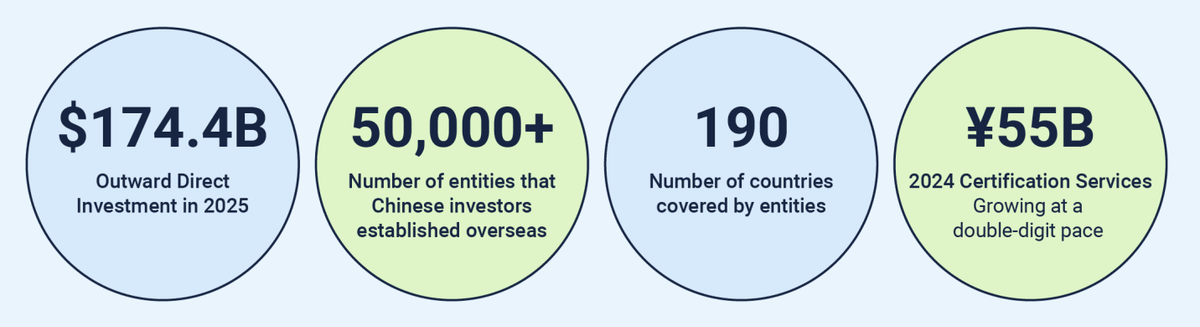
By the end of 2025, Chinese investors had set up more than 50,000 entities across 190 countries, backed by $174.4 billion in outbound investment for the year alone. That's not a one-off spike. It's the leading edge of a structural shift in how Chinese companies do business, and it's creating an opening that most international organizations haven't fully clocked yet.
We cover this shift in depth in our latest whitepaper, Strategic Opportunities for Global Associations in China. Here's a preview of what's in it, and why it's worth 15 minutes of your time.
Key Takeaways:
- China's outbound wave is structural. Domestic hyper-competition (Neijuan) is pushing Chinese companies overseas faster than most international organizations have caught up to.
- The scale is already massive. Chinese investors opened 50,000+ new entities across 190 countries in 2025 alone, backed by $174.4 billion in outbound investment.
- The barrier isn't interest, it's awareness. Many Chinese firms assume all associations work like China's government-run organizations, so they never realize what independent global networks actually offer.
- Your outreach stack likely doesn't reach them. Roughly 79% of Chinese professionals discover organizations through WeChat, Douyin, and RedNote, not LinkedIn, Google, or email.
- One campaign isn't enough. The organizations winning in China built their credibility over years of consistent, localized presence, not a single push.
- The opportunity rewards whoever shows up first and stays. Capturing this wave takes a deliberate framework, not passive visibility, and the playbook is in the full report.
Why Chinese Companies Are Suddenly Everywhere
The trend has a name in Chinese business circles: Neijuan (内卷), or "involution," a term for hyper-competitive domestic markets where doing more and more just doesn't move the needle anymore. Margins shrink, customer acquisition costs climb, and the market stays just as crowded no matter how hard any single company pushes.
The response is Chuhai (出海), literally "going out to sea." China's largest companies moved first, building overseas infrastructure to escape domestic saturation. Now a much bigger wave is following: mid-market firms with solid revenue and proven products, but without the overseas legal teams, logistics networks, or brand recognition the giants already built for themselves.
That gap is exactly where international associations, and the organizations that work alongside them, can step in.
The Barrier Isn't Interest. It's Awareness.
Here's what surprised us most in the research: Chinese companies aren't uninterested in Western associations and international networks. They often don't know these networks work differently from what they're used to.
In China, large industry associations frequently operate as Government-Organized Non-Governmental Organizations (GONGOs), extensions of state policy rather than commercially-driven, peer-to-peer communities. When a Chinese company hears "international association," that's often the mental model they default to: administratively structured, more useful to regulators than to members. The idea that a global association might offer direct, trusted access to international buyers and partners, independent of government control, simply isn't on their radar.
That's not a small marketing problem. It's a completely different starting assumption that has to be addressed before any pitch about membership or events even lands.
The Digital Mismatch Nobody Budgets For
Even organizations that get the awareness problem right often stumble on the next one: where Chinese professionals actually go to research who to trust.
Roughly 79% of internet users in China use social platforms to learn about brands and organizations, but the platforms doing the discovering are WeChat, Douyin, RedNote, QQ, and Baidu Tieba, not LinkedIn, Instagram, or email. Google is blocked outright. LinkedIn shut down its localized China platform entirely. An outreach strategy built on the Western stack is, for practical purposes, invisible inside China's digital ecosystem.
Our whitepaper walks through what actually works instead, including how organizations are adapting content for China's growing AI-driven discovery layer (think DeepSeek and Qwen, not Google search), and what it takes to get verified on WeChat and hosted on a .cn domain without the process stalling out for months.

What the Winners Are Doing Differently
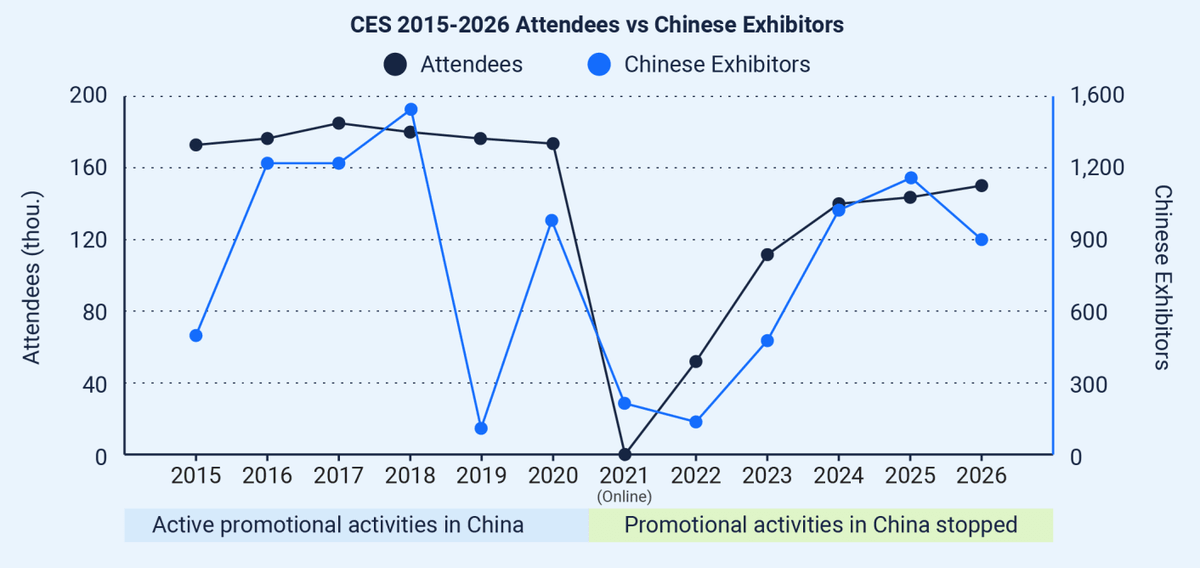
The report includes a handful of real cases that make the pattern concrete: an association that built certification infrastructure in China over more than a decade and now counts nearly a third of its global certified professionals there, a global tech show that built years of consistent, localized social presence before its Chinese attendance numbers ever took off, and a counterexample of what happens to that same momentum once local investment stops.
The throughline across all of them: this isn't a campaign you run once. It's infrastructure you build once, and then keep showing up to.
Where to Go From Here
If your organization is trying to figure out how Chinese companies fit into your growth strategy, or if you've already tried and hit a wall you couldn't quite explain, this is worth reading in full. The whitepaper breaks down the data behind the shift, the specific barriers most organizations don't see coming, and a practical framework for building a presence that gets noticed, trusted, and acted on.
Download the full report here to get the complete picture, including the case studies, the data, and the framework.